
By Dr. Cathleen King, DPT
It Starts With a Bike
I want to do a little exercise with you, because I think it might actually teach you what I’m talking about better than any explanation could, so if you can, close your eyes for a moment or just soften your gaze, and imagine that you are six years old.
It’s a warm afternoon and you’re riding your bike down the sidewalk in front of your house, going a little too fast the way six-year-olds do, and your front wheel catches on something and you go down hard. You look down and your knee is scraped open pretty badly and it’s bleeding, and of course you start to cry, because it hurts and you’re scared of all that blood.
That scraped knee is real, and it’s not something you chose or something you can make stop just by deciding to. In Primal Trust™ we call this the first reaction, which is the sensation, the symptom, the trigger that shows up in your body that you really don’t have conscious control over.
But what happens next is where everything changes, because in just a moment the grown-ups are going to come out of the house, and the way they respond to you is going to teach your brain something about what pain means that you may carry with you for the rest of your life.
Two Ways the Grown-Ups Come Running
The first version
So you’re crying and holding your knee, and out of the house come your mom and dad. And I know some of you did not have regulated parents, so if that’s you, I want you to just make it up, and imagine this beautiful, nurturing feminine presence and this steady, protective masculine presence coming toward you together.
They scoop you up in their arms and they just hold you while you cry, and you’re telling them what happened and showing them your knee, and you’re a little afraid of the blood, and they say, "We’ve got you. We’re right here."
Now I want you to notice what happens in your body as you’re being held by something bigger than you, because your knee is still bleeding and that first reaction hasn’t gone anywhere. Does being held make you more stressed, or does it help you calm down a little, and are you able to be with that bleeding knee just a little bit more?
Then once you’ve settled, your dad takes a closer look and says, very calmly, "Okay, that cut is a little deep, so we’re going to wash you up and we might have to take you to get some stitches." He’s still taking action and you’re still going to get the care you need, but notice what they did first, which was to hold space for that first reaction until you calmed down.
The second version
Now let’s shift it, because this is what so many of you are doing. Same afternoon, same bike, same fall, same scraped and bleeding knee, and you’re screaming. Your parents hear you and they come running out of the house screaming too, "Oh my God, oh my God, you’re bleeding! Call a doctor, we might need to get you to the emergency room, what if you get a staph infection?"
They’re frantically trying to figure out what it means and what could happen and what to do, taking urgent action, and they scoop you up and put you in the car and race you to the hospital, where you get your stitches.
You were still attended to and you still got fixed, but I want you to really feel what the stress chemistry was like in your little body on that drive, because the cut was exactly the same and the care was exactly the same, and the only thing that was different was the response surrounding it.
The Second Reaction Is Where We Get Hooked
The reason I tell this story is that so many of you living with chronic symptoms are being that second set of parents to yourselves every single day, and you don’t even realize it.
A symptom shows up, maybe it’s dizziness or a gut flare or a racing heart, a funny feeling after you ate something, or even the upset of feeling a little rejected by someone you love, and that’s your scraped knee, that’s the first reaction. And then your brain gets involved, and your brain loves to predict what things mean, so it says this means I’m getting worse, this means I ate something bad, this means I’m going to be up all night, this means they don’t care about me, and a story gets created.
Here’s the big question I want you to start asking yourself: are you going to take the bait? Because that story is like a fish hook that has caught you over and over and over again, and as soon as you believe it, you go down a tunnel of emotion, usually fear or dread or anger or guilt or shame. And your brain, which is wired to protect you from those feelings, has all these strategies to fix it or escape it, so you Google your symptoms, you run to the supplement cabinet, you book another appointment with another promised healer, you scroll, you clean the whole house, you eat something to settle yourself, you research late into the night.
And just like the fish hook usually has a tasty little bit of food on the end, all that fixing gives you a moment of relief, and that relief teaches your brain that when this yucky sensation shows up, the way to get through it is to predict, panic and fix. What it doesn’t teach your brain is that this never actually works for good, because all of that urgency, the scrolling and the Googling and the coping, is producing stress chemistry, and that stress chemistry feeds right back into the first reaction, into the inflammation and the overreactive immune system and the under-functioning digestion and the insomnia.
So what I’m really describing is a kind of addiction cycle, and we don’t usually think of it that way when we’re trying to heal chronic illness, but we do have one, and it’s this coping strategy that I call the neural circuit of stress, which just keeps reinforcing itself.
I Was the Frantic Parent to Myself
I know all of this so well because I lived inside this loop for years. I had severe panic and anxiety for a very long time, and I was very well versed in fixing and monitoring myself, constantly checking whether the dizziness was coming back, whether that room had chemicals in it, whether I was starting to feel funny after a meal, whether I’d overdone it, and whether I was going to be able to sleep that night.
And my go-to second reaction, honestly, was understanding. I really believed that if I could just understand it, then I could finally relax, so I read the countless books and learned all the science and took all the notes, and it took me a long time to see that all of my trying to understand was part of the second reaction too. It was just another way of grasping for certainty and control.
“Understanding is not regulation.”
You can learn every bit of the science behind nervous system regulation and still not have the embodied experience of creating more safety inside of you, and when I think about all the time I spent researching, I could have been doing simple practices of just sitting with myself and breathing and being here now, and it would have been enough. I can feel how the brain says that’s not enough, I need to learn more and know more to get better, and I know some of you are laughing right now because that’s your go-to as well.
I also want to make sure you hear that none of this is about shame or about doing it wrong. This is a habit in our whole collective culture of how we attend to our bodies, because most of us didn’t grow up with the rituals and containers that taught us how to tend to distress, so we are all in very good company here.
What Your Tools Are Really For
Okay, so here’s the big missing piece in the whole nervous system world, and I want you to really put your ears on for this one, because it is so misunderstood.
Most of you come to a breath practice or a regulation tool hoping it will make your symptom go away, and of course you do, because you’re hurting and you just want it to stop. And here’s the tricky part, which is that the tools do work a lot of the time. They give you relief, they change your biochemistry, and they help things regulate, and it took me years to really tease this apart for myself.
But if you’re reaching for your tools the same way you reach for the supplement cabinet or the Google search, they just become one more way of fixing, and even though your system may calm down, that whole strategy of fixing yourself stays embedded, so you end up going from one problem to the next. Maybe it moves from your body to trying to control your partner or your child or someone else, and the loop just keeps perpetuating.
So I’m asking you to use your tools for a different reason. Your tools are the parents who come out of the house and hold you while your knee is bleeding. You’re using them to build the capacity to be with the first reaction, so that you can get centered before you make any decisions about how to address it.
And that doesn’t mean you don’t take action, because the calm parents still took their child to get stitches. If you have a migraine and you need to take your medication so you can perform that night, take it, and if your doctor has you on a protocol, follow it with discernment. The difference is the place it’s coming from, because when you’ve held yourself first, a discernment comes online that can say this isn’t a five-alarm fire and my body is working through it, or okay, this one needs some care, and I’m going to get it, and that is embodied wisdom, that is your inner parent.
What the Brain Learns for Next Time
Let’s go back to that kid whose parents came out screaming and rushed them to the hospital, because I want you to think about what happens the next time that child falls off their bike and scrapes their knee. What do you think the brain is going to predict? It’s going to predict a five-alarm fire, and it’s going to run that whole stress chemistry all over again, while the child whose parents held them first is learning something completely different, which is this hurts, and it’s something to attend to, and I’m safe while I attend to it.
The same thing is happening inside of you every time you meet a symptom. When you can notice it and just calmly register it, okay, I’m having a stomach flare right now, without rushing off to figure it out, your limbic system starts to notice that nobody’s freaking out, and over time your brain begins to learn that this sensation isn’t the danger it has been thinking it is.
And this matters so much, because when the limbic system gets involved it amplifies everything, so you don’t even know anymore what’s a real condition you’re physiologically dealing with and what’s a limbic storm of stress physiology putting fuel on the fire. As that circuit quiets down, your body gets better at discerning threat from non-threat, your immune system becomes more discerning instead of being hypervigilant in some ways and underactive in others, and your digestion and your sleep have room to come back into balance.
If no one ever modeled this for you
I did not grow up with regulated parents who helped me learn how to do this, and I know many of you didn’t either. There’s a whole field of research called psychoneuroimmunology that looks at how growing up with a lot of trauma, or in a dysregulated environment, or with parents who weren’t there for you, is connected to a greater likelihood of chronic illness and immune system issues, and when I think about the scraped knee, that makes so much sense to me, because our ability to regulate that first and second reaction was simply never modeled for us.
But the good news is that you can rewire this, and you can become the inner parent for yourself that you never had, and that’s exactly what we’re doing together.
Try It With Me Now
Let’s make this a little more applicable, because I don’t want this to just be an idea in your head. Close your eyes and think of the latest symptom that’s been bothering you, or the person or situation or trigger that’s been pulling at you lately, and then I want you to pattern interrupt, so maybe you clap your hands, or you put your hands firmly on your thighs and rub them and just say to yourself, be here now, be here now, and take a deep breath.
Now open your eyes and do your best to let go of the story, even if the symptom is still there, and look around the room for something that’s interesting to you, maybe a flower or a plant or a lamp. Then come back to your body and say, I’m going to be here now, I’m going to breathe in my belly, and I’m not going to do anything to fix this, I’m just going to practice being here. You might need to tap on yourself a little as you stay with it.
And as I encourage you to stay with that first reaction and not follow the story or the urge, I want you to notice what’s coming up, and what part of you wants to do instead. For some of you it’s emotional eating, for some of you it’s scrolling or exercise or going to the supplement cabinet, and for some of you it’s research. That’s what I call the tug, and it’s the part of your brain that has learned you get relief by self-abandoning and fixing, so when you start attending to yourself by breathing and being here now, it might even feel unsafe and bring up more anxiety at first, because it’s trying to pull you back into the old coping strategy.
You don’t have to make the tug go away, you just get to notice it. And this is how you’ll know you’re making progress, because there’s going to start to be a little bit of space between that first reaction and the urgency to go fix it, where you actually feel the pull to go scroll or distract or Google or freak out, and you see it as an observer, maybe even just for two seconds. That’s how you know you’ve interrupted the neural circuit of stress.
You Can Become the Parent You Needed
So here is my invitation to you. Anytime a symptom shows up, or someone triggers you, or you wake up in the middle of the night with your heart pounding, I want you to imagine those two loving presences coming toward you, your inner mother and father, your inner wisdom, scooping you up and saying, I’ve got you, and I’m going to be here now with you while we breathe through this.
The scraped knee might still sting, and the dizziness or the gut flare or the ache of feeling a little rejected might still be there, but you’re no longer abandoning yourself in the middle of it. That’s how you start building a container of safety within you, and over time that container will reroute how your brain predicts and how your physiology responds.
And it leads to a kind of freedom that I want so badly for every one of you, which is knowing that no matter what happens, whether you lose someone or have a health scare or lose a job, you have the capacity to be with a lot of discomfort. That is what I mean by primal trust, the ability to trust life itself even when it’s not fun.
I’m so proud of all of you brave souls who are willing to practice this, because it means breaking patterns that are deeply ingrained and counterintuitive, and I promise you it is absolutely possible.
Practice this with me every day
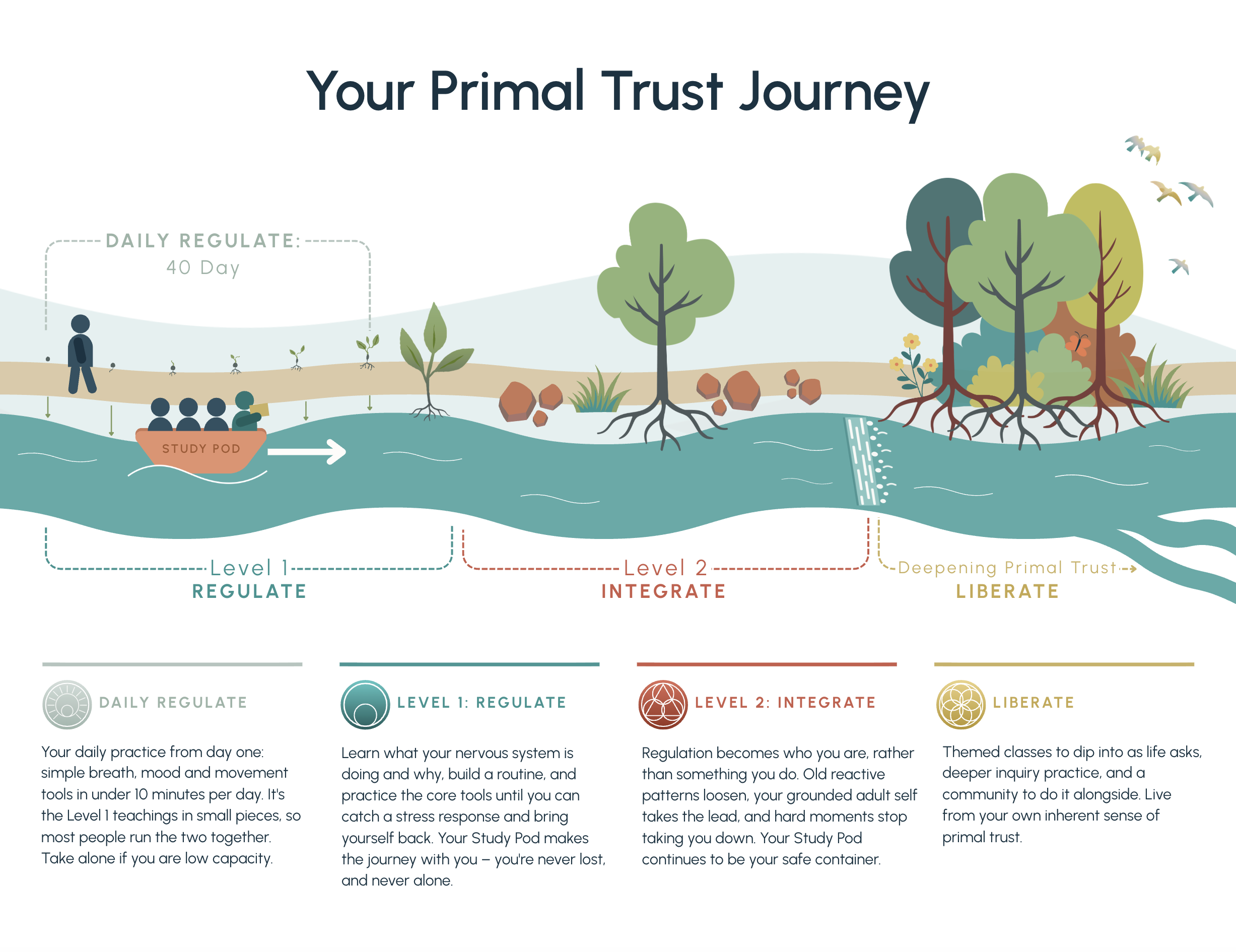
The practice in this post comes straight from Week 1 of Daily Regulate™, my 40-day journey for building a whole new relationship with your nervous system just a few minutes at a time, where each day I share a short teaching and a simple practice you can follow along with, so you never have to figure out on your own what to focus on next.
Daily Regulate™ is included in your Primal Trust™ Academy & Community membership, along with Guide-led Study Pods that walk you through the program in a small group so you don’t have to do this journey alone.
If you’re not sure yet whether Primal Trust™ is the right fit for you, book a free 20-minute discovery call with our team and we’d be happy to help you figure it out.
This post is for educational purposes only and is not medical advice, diagnosis or treatment. Please continue to work with your healthcare providers on any medications or protocols.
Adapted from Dr. Cat's teaching in the Week 1 Daily Regulate™ LIVE Integration Class, October 6, 2026.